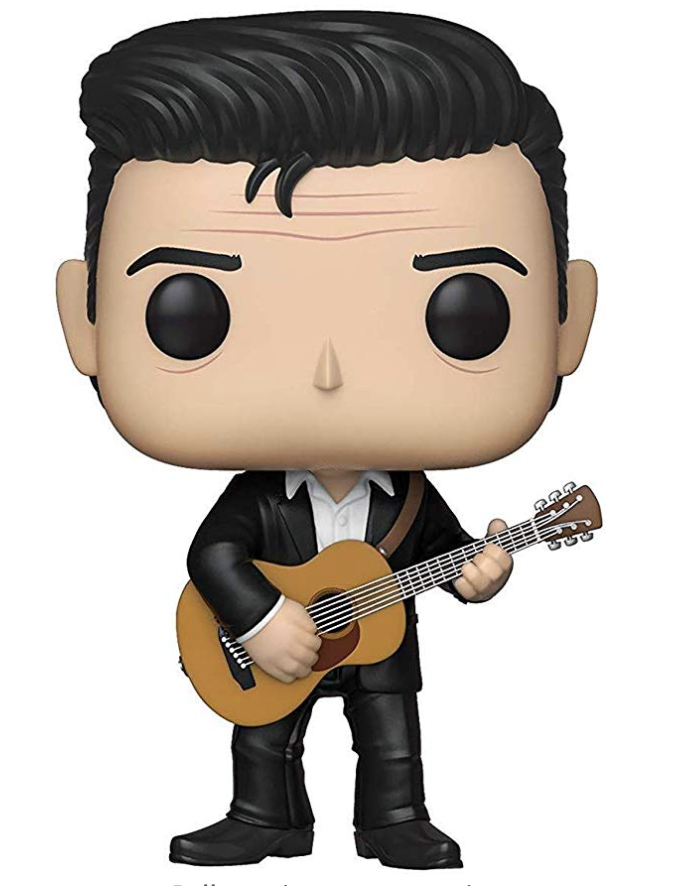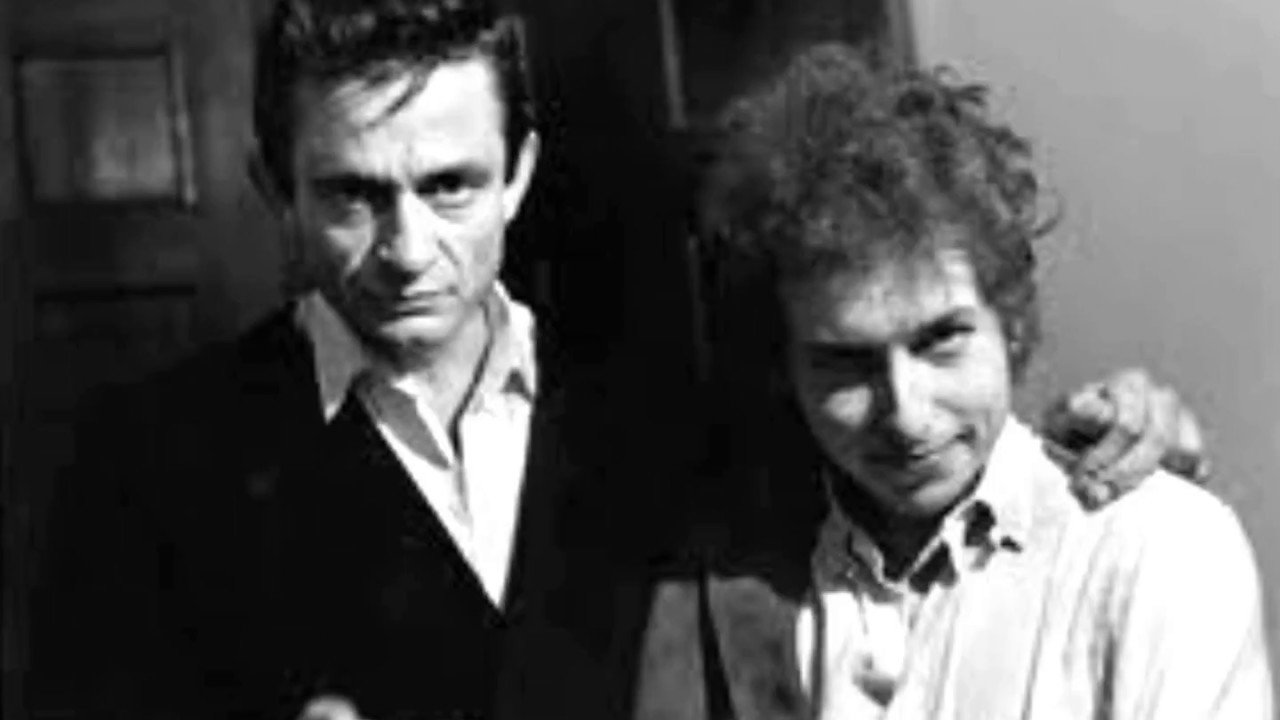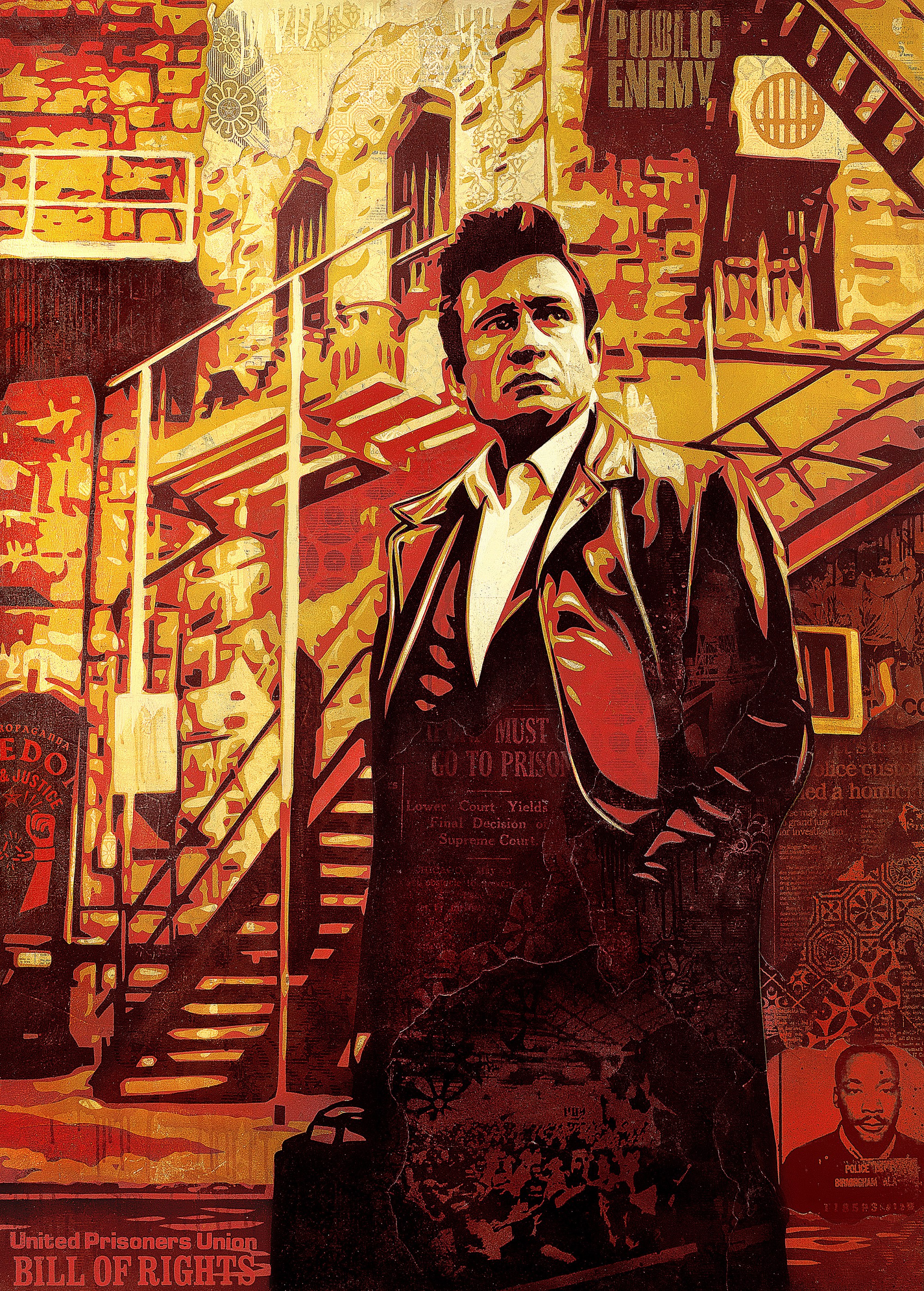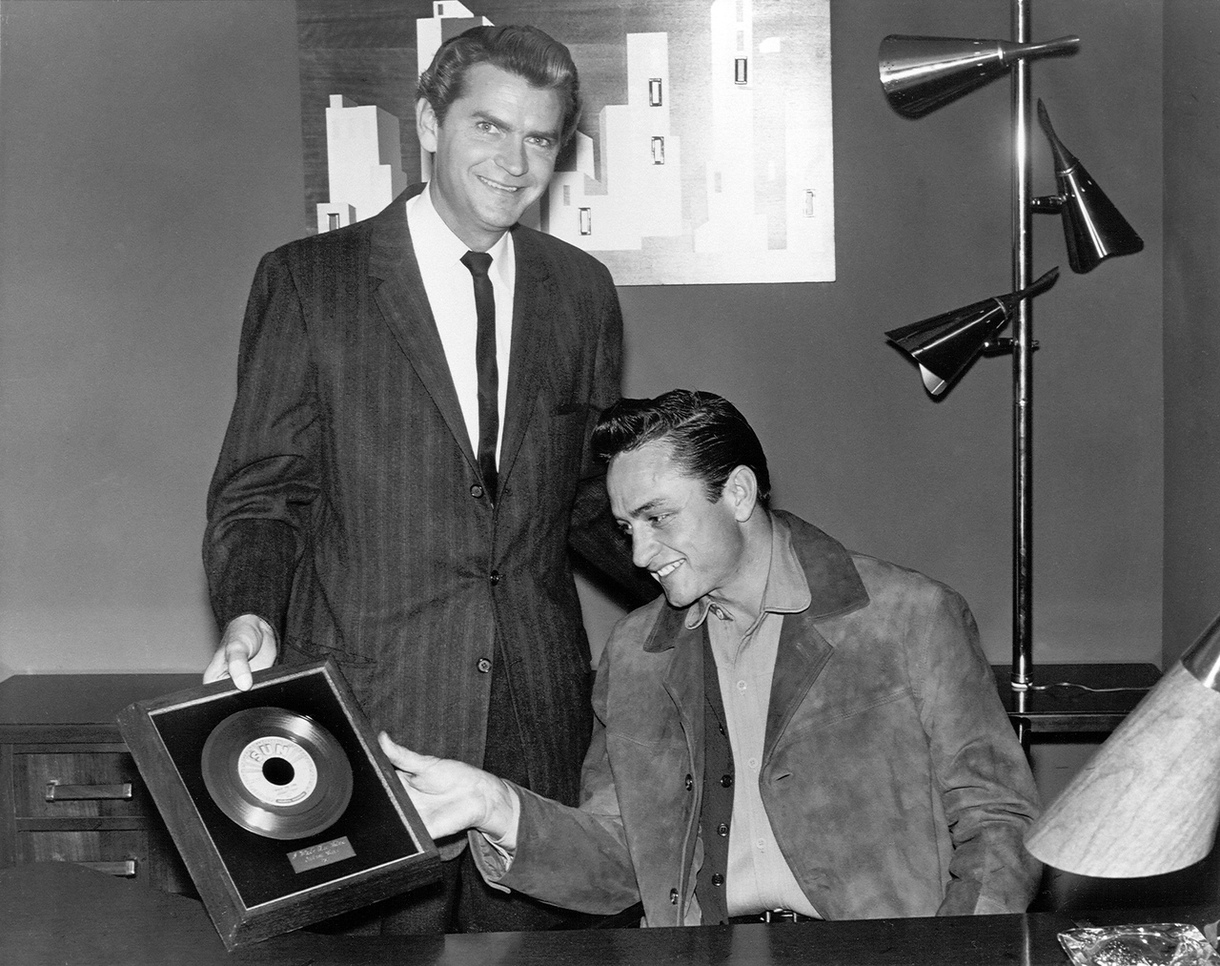
The Johnny Cash “Forever” Stamp celebration took place June 5th at the Ryman Auditorium featured John Carter Cash, The Oak Ridge Boys, Marty Stuart, Randy Travis, Carlene Carter, Wesley Orbison and other members of the Cash family to kick off the release of the limited-edition stamp
A “forever’stamp is a non-denominated stamp that retains full validity postage no matter of price increases.
Kathy Cash , Johnny’s Daughter from his first marriage to Vivian Liberto Distin and sister of Rosanne Cash, posted her heartfelt and funny speech from the event. I re-post it here with a video of a rousing “Will The Circle Be Unbroken” from the finale. Enjoy.
___________________________________________________________
Good Morning.
Thank you for being here to celebrate the “Johnny Cash Forever Stamp” in the Music Icon series.
My dad and mom had a 4 year courtship in the early 50′s. Dad was in the Air Force in Germany, mom was a young woman living in San Antonio, Texas. During that 4 year period, they exchanged an astounding 10,000 letters.
Dad was no stranger to licking a stamp.
He loved stamps and we have the letters to prove it.
When dad was on the road until he retired, he sent us hundreds of cards, letters, poems and Valentines, postmarked from all over the world. When he heard a new upcoming artist on the radio and liked what he heard, he always sat down to write a letter of encouragement.
Always postmarked, always mailed.
In a fast paced world of telegrams and faxes, then email and texts, dad always preferred and chose writing. It meant a great deal to him to send a handwritten letter, stamped and mailed to people he cared about.
Dad has been inducted into all 4 Halls of Fame : Country Music, Songwriters, Rock and Roll and Gospel. He received the Kennedy Honor Award, The National Medal Of Arts, and was the first person to receive the Spirit Of Americana “Free Speech Award.” He earned thousands of awards for his musical accomplishments and humanitarian works. There’s even a main street in Hendersonville, TN., named “The Johnny Cash Parkway.”
Dad loved this country. I have no doubt that having his image on a United States postage stamp would be his proudest accomplishment.
If dad were here he’d be beaming with pride, and would say something to the effect of, “Well. Ain’t that somethin’? This face of mine on a postage stamp. A government issued postage stamp. A FOREVER STAMP.” He would love that it’s a forever stamp.
Dad had such an impact on American history. To have him recognized in this capacity is incredible. It means future generations will realize what a monumental part of American history and music Johnny Cash is.
On behalf of the entire Cash family, I want to thank the United States Postal Service, the fans and collectors who initiated and participated in this remarkable effort, voicing their support for a Johnny Cash stamp.
I’m not sure if I was the first to coin the term but I’m pretty sure i was the first to tweet it – that’s so country it’s Americana.
By that I mean as Music City continues to do what it’s always done, chase trends to broaden consumer acceptance, fill radio slots and asses in arena seats, and make truckloads of money, who looks after the legacy of the music? The legacy of twang, soul and grit that Rodgers, the Carters and Hank Sr. left us? The focus on the song as deep, personal expressions and not just target-marketed laundry lists? Ladies and gents it’s Americana straight up.
sure music Row still determines the brand “Country Music” but they don’t won the legacy or spirit. Tom Petty hit the nail squarely in the noggin when he described contemporary country music as “Bad rock with a fiddle. Zing! While the rhinestone cowboys chase hits and eschew tradition (Blake!) the real soul of country music has found a new home in the Americana camp. Now by Americana I also include the underground, muddy roots acts as well, as I believe a lot of the passion and blue-collar core is often found on that side. Here are a few videos to make my case.
Legacy: in their golden years no one in Music Row bothered to return phone calls to Johnny Cash and Porter Wagoner who were still viable a, had songs, and wanted to work. It took hip-hop/rock producer Rick Rubin and musician/producer Marty Stuart to work with these legendary men, respectively, and understand their storied place in music history. Working with their own label (Rubin) and an L.A. rock label (Epitaph) allowed these legends to produce some of their best work at the end of their lives and leave this world with dignity and fans with a few more treasures. Hell, even country music legend Lee Ann Womack teamed up with Americana stalwart Buddy Miller to stretch her wings.
Johnny Cash – “Hurt” (Nine Inch Nails)
Porter Wagoner – “Committed to Parkview”
Leann Womack & Buddy Miller – “Don’t Tell Me”
Soul – At it’s core country music is soul music. It bleeds life in common stories plaintive and wondrous. Here are some performers that reflect that rough beauty.
Robert Ellis – “Cemetery”
Jason Eady – “AM Country Heaven”
Elizabeth Cook – “Mama’s Prayers”
www.twangnation.com/blog/wp-admin/post.php?post=5944&action=edit
Twang and Grit – Musicianship has always been the stock and trade of country music , but it used to be more than a backdrop for party anthems. Here are some that are tearing it up without dumbing it down.
Sturgill Simpson – “You Can Have The Crown / Some Days”
Whitey Morgan and the 78′s – Cocaine Train
Turnpike Troubadours – “Before The Devil Knows We’re Dead”
The United States Postal Service, John Carter Cash and other members of the Cash family will the release of a limited-edition Johnny Cash Forever stamp June 5, 2013 at historic Ryman Auditorium (116 Fifth Avenue, Nashville) at 10:30 a.m. CDT. Doors open for stamp sales at 9 a.m. and the event is free and open to the public.
Artists set to appear, perform or speak include John Carter Cash, Carlene Carter, Larry Gatlin, Jamey Johnson, The Oak Ridge Boys, The Roys, Marty Stuart and Randy Travis among others. 650AM WSM personality Bill Cody will serve as emcee of the event.
“It is an amazing blessing that my father Johnny Cash be honored with the issue of this stamp. Dad was a hard-working man, a man of dignity. As much as anything else, he was a proud American, always supporting his family, fans and country. I can think of no better way to pay due respect to his legacy than through the release of this stamp,” said John Carter Cash.
“My family is thrilled that my father will grace a United States ‘Forever’ stamp, a great honor for any American, and an honor that would have particularly delighted him. It is a joy to know that generations will use this stamp, and my father will forever be where he loved to be: traveling the world,” added Rosanne Cash.
About the Limited-Edition Johnny Cash Forever Stamp:
Designed by art director Greg Breeding, the Johnny Cash stamp features a photograph captured by Frank Bez during the photo session for Ring of Fire: The Best of Johnny Cash (1963). The stamp is part of the U.S. Postal Service’s Music Icon series, which also includes stamps honoring Lydia Mendoza (available now) and Ray Charles (to be released in September).
The stamps will be available for purchase at the Ryman Auditorium June 5 from 9 a.m. until 1 p.m., at the CMA Festival Fan Fair X at LP Field June 6-9, local Post Offices and online at usps.com/stamps.
Hurray For The Riff Raff are a young band enjoying a good deal of buzz, but don’t let that mislead you into thinking they are the flavor of the week. They balance the hype by deftly exploring and evolution of roots and folk, namely Americans music. At 25 years old the band’s front woman, creative and spiritual guide Alynda Lee Segarra, is already an accomplished singer-songwriter having been a solo performer before joining in with the loose collective that is Hurray For The Riff Raff.
After seeing HFTRR captivate a capacity crowd at San Francisco’s Amnesia bar I realized this might be the last time I was able to see them in such an intimate space. They are about to become one of those bands that will break big but, I believe , will still embody a authenticity of artistry and spirit that drew me to them in the first place.
The following is a brief email interview I conducted with Segarra. I hope you enjoy it.
Baron Lane for Twang Nation: First off, thanks for taking the time to answer a few questions for my readers. I saw you and the band at Amesia in San Francisco last week and the place was packed. I believe you could have filled a place twice it’s size. Has this been the typical reception to your current tour.
Alynda Lee Segarra from Hurray For The Riff Raff: We always have a great response in SF. The west coast is definitely more foreign to us as a band because we don’t get out there as much as we’d like to. But there are certain cities that treat us like we’re at home, SF/Bay area Oakland definitely is one of those cities!
TN: Does the name ‘Hurray for The Riff Raff’ reflect a personal or band identity or creed?
ALS: I really relate to the name, it’s about cheering for the underdog. I’ve always felt like an alien, as a child I felt like I was born in the wrong era, I was obsessed with the 1950′s and I was sure there had been a mistake. It had a lot to do with the music of that time but it was something more than that, I felt like I wasn’t made for “modern times” in America. I longed for something older, for a way of life that had been basically stomped out. I felt I was born into a world where everything had been discovered, explored, bought up and sold already. As far as music to inspire me, when I was a child the radio had the Spice Girls, NSync, all this crap that I knew I was supposed to like but did nothing for my soul. It was the old music that did it for me. Doo Wop, Motown, and then Rock n Roll as I grew up.
I was in the middle of NYC, which was a blessing and a curse. I saw a long life ahead of me working, buying, and working some more, struggling to survive in such a competitive and increasingly expensive city.
It all lead me to work really hard at finding an alternative way of life, and I was lucky enough to be able to take a chance and leave. Everyone in the band is a fucking weirdo, although we may not look like it! But we are! And that’s the beauty of it. We have all had that desire to search for something…”real” I guess is the word. I don’t know what the word is.
But now that we play and write music, we get to add to this scene that we’ve wanted our whole lives. A music scene for weirdos who want to get down to some good music that sounds old and new at the same time. To create a music scene that isn’t bought up and sold yet. Anyone who wants apart of that is riff raff to me.
TN: Was music a part of your life growing up in the Bronx?
ALS: I have always escaped through music. I used to obsessively learn lyrics when I was a kid, I’d learn songs from old musicals like “West Side Story”, “The Wizard of OZ”, “Singing in the Rain”. I loved the way those actors sang, I liked the way they pronounced their words, their tone etc. When I got older and started getting more rebellious I was discovering the punk scene in the Lower East Side. I’d take the subway and go to a show down there, it blew up my world. I loved the live shows, and I loved the political messages a lot of the bands had. I really started connecting to feminist punk bands, it gave me this sense of pride and courage that was really important for me as a kid.
TN: You left home at 17. Being on your own must have been tough. How did you manage?
ALS: I followed my instincts, had some rough times, relied on a lot of friends. I had to go through that time period in order to be who I am today.
TN: Was the guitar your first instrument? Do you play anything else?
ALS: I played a little guitar in middle school, but nothing big. I guess I consider the washboard my first instrument. I started playing it with the Dead Man Street Orchestra, when I was traveling with them. I just loved being in charge of the rhythm, it gave me enough confidence to go on to learn the banjo and then meet up with the guitar again after that. I play a little piano at home, I wanna start jamming on the harmonica next!
TN: Who are your singer/songwriter inspirations?
ALS: Wow, I have a lot! Gillian Welch is a HUGE inspiration to me, she is brilliant at crafting a song. She is a bridge between the old world and today, and I’ve learned a lot from listening to her. Of course there’s John Lennon, I personally connect to his acoustic album that was released after his death. A lot of demos and just a raw portrait of him as a songwriter. Early Bob Dylan of course, Neil Young. But there’s so many musicians of today that I listen to that push me to work harder. Shovels and Rope, John Fullbright, The Alabama Shakes, Clear Plastic Masks, Sam Doores and Riley Downing. I feel so lucky to be able to see these guys live and be peers with them. Everyone is pushing each other to do their best.
TN: What were the events that led your from road kid to The Dead Man Street Orchestra?
ALS: We all fell into a family sort of dynamic in New Orleans. It was a really incredible time, probably one of the happiest I’ll ever be. It was the year before the storm, the winter time and we were between halloween and mardi gras. We actually played all together for the first time in Jackson Square on Lundi Gras day. I first played music with two of the members Kiowa Wells and Barnabus Jones at the railroad tracks. We sang some Johnny Cash songs and I played washboard with some seashells i found. i was hooked, I needed to play music all the time. I owe my life to all those guys, they’re all so talented and taught me so much.
TN: You self-released two albums (2008s It Don’t Mean I Don’t Love You and 2010s Young Blood Blues) as a solo act under the HFTFF moniker. You then recruited the Tumbleweeds to back you. Why did you decide to take HFTFF to a fill bands instead of a solo act?
ALS: It was always a full band, just had different members. It was a really different sound for the first two records, I was inspired by a sound that was very New Orleans at that time. A lot of the young artists there were playing this dark/gypsy banjo accordion stuff, and I loved it, but I grew out of it. Sam Doores and Dan Cutler helped me grow into the sound I wanted. Yosi Perlstein had been with me since Young Blood Blues and he was so important with the change because his drumming added to my more “rocking’ songs but he could also play a mean country fiddle. I got lucky with these guys!
TN: “Look Out Mama” draws from a variety of styles to form a organic body of work. What’s your view on genres in regards to your band?
ALS: I’m not good at genres, Sam is way better at that stuff. I just say we play Americana, Folk/Country whatever. But there’s a lot of old blues in there, early Soul and R&B.
TN: I’m interested in the unexpected album cover for “Look Out Mama.” What is it depicting?
ALS: It’s my father. He’s about 19 and in Vietnam. His buddy took that picture and it’s hung up in his hallway at home. I grew up with that picture, it was burned into my subconscious. I thought a lot about it, how it must have been to be so young and thrown into that situation. What it must have been like to come home and have to get back to everyday life. It made me think a lot about people I meet, where they are coming from, what they’ve been through.
It also made me question our government from a very young age. Was it worth it? Was it worth all the lives that had to be repaired? The ones we lost? I thought it really fit the music of the album, and it had been recorded while my community in New Orleans was mourning the loss of a friend who had been murdered in his house.
It was a time that I was thinking a lot about violence, about how it’s being fed to us. How we’re killing each other, and when I think about it too much it drives me crazy. A lot of people are talking about violence in the media, which is a worthy discussion, but why don’t we think that the wars we are in overseas will come home at some point? The poverty and anger, the hatred against our neighbors. We got a lot of work to do.
I just wanted to create something positive. I write about my dad on the back of that album, about how he inspires me to be hopeful and to try to make something different for the world.
TN: You come from Puerto Rican roots. How has that shaped your music?
ALS: When I started growing into an adolescent I was drawn to a music and style that has a predominantly white audience. For some reason at that age I felt shame about who I was. I didn’t “belong” with ether group of white punks or your average New York Puerto Rican. It led to me to really search within myself for who I wanted to become. I didn’t have a role model who looked just like me. I had to pick and choose what inspired me from a wide variety of sources with all different faces and backgrounds. I also learned that I don’t want to be apart of any scene that doesn’t celebrate difference.
The punk scene was incredibly important to me when I was a teenager, but I also felt a lot of stress on pretending I was exactly the same as all the other kids. When in reality I grew up very different than most of the white kids who were around. My family was different, we dealt with different hardships, we ate different food, we talked different. But in the punk scene we were all supposed to be the same. But there are some differences that are meant to be treasured, so we can truly learn from each other.
I remember feeling like somewhere along the line I had chosen to be white. But I never would truly be, no matter what the outside world perceived me as. Poetry taught me who I was and the beautiful history of Puerto Rican poets inspired me. Poetry was where I felt at home. I remember reading Puerto Rican poetry from the LES and realizing that writing was an integral part of my path in life. I remember reading a poem that read “Puerto rico is a beautiful place, Puerto ricqueno is a beautiful race” and that just rung out forever in me like a bell. I wanted to start combining my worlds. It lead me to folk music, which lead me to traveling and Woody Guthrie and political musical figures who believed in the soul and the struggle of the people.
Being Puerto Rican is at the core of my existence, it is the landscape of my family’s experience and so it is mine. It also changes my feminist experience. It is a gift to me, that I get to see the world I see through Puerto Rican eyes, I can bring a little something different to the table. It’s also meant that I have a lot of anger inside me because I want all people of color to be free. I want to break down the traps that are set up before them to keep them in their place.
Now I play folk music. I’m not letting anything stop me from being wholly who I am anymore. I’m going to create a space for myself to be entirely who I am. Folk music encourages that, the Queer scene around the world encourages it, New Orleans encourages it as well.
TN: What is your process for creating songs? Slow incubation or flash of inspiration?
ALS: I have to catch the tunes as they fall on me. They come fast and not always complete, i’ve learned to keep a recorder handy. I’ve learned to honor the song when it comes. Sometimes you have to be late, sometimes you have to turn off your phone. Townes Van Zandt said he never gave up on a song. That’s quite a thing to say because a lot of songs come to us writers. To give each and every one a solid try is really doing good work. That’s what I strive for.
TN: and last, what’s next for HFTRR?
ALS: This summer we’re gonna be doing a lot of touring that I’m super excited about, and hopefully putting the finishing touches on our new album. I want to play a lot of festivals, make some new friends and keep writing. I got a feeling 2013 is gonna be a good year for the ole’ riff raff.
For a movie slated for test-screening next month in Charlottesville, VA (fitting since the the movie takes place in Virginia) details on My Fool Heart (Facebook) are as rare as hen’s teeth.
Here’s what we do know, first the official story brief : “… Jim Waive stars as a humble Virginia diner singer who is the target of two London hit men in the debut feature film MY FOOL HEART from writer-director Jeffrey Martin.” “Throughout the movie, Jim Waive keeps losing his treasured possessions. Justin plays the Mysterious man who finds Jim’s lost things on the sidewalks of Nashville.”
Then there’s the extraordinary cast from Americana, Country and Bluegrass music fields – Elizabeth Cook, Justin Townes Earle, Merle Haggard, Wayne Henderson, Sarah Jarosz, Jim Lauderdale, Charlie McCoy, Jesse McReynolds, Dr. Ralph Stanley and Jim Waive and the Young Divorcees
Then there’s the oddly dark “Popcorn teaser” posted on YouTube.
I contacted the writer-director Jeffrey Martin on the road to shed some light on this intriguing film. He was very forthcoming in an email interview on his motivation for the film and how how love of music helped to influence My Fool Heart.
I very much look forward to seeing this film soon and readers of this blog might feel the same way after reading this interview. Enjoy
Baron Lane – Who are some of your influences as a director?
Jeffrey Martin – MY FOOL HEART was influenced by Cassavettes and other directors who believed even if your bank account was low you could grab a camera and make a movie. It’s a stupid idea but it obviously influenced me. When you make a really cheap film, you get to call the shots and take extravagant chances. Sometimes they pay off.
BL – My Fool Heart is billed as a comedy, but based on what i’ve been able to glean online it looks more like a black comedy. Is that accurate?
JM – Most black comedies have a more bitter or cynical take on life. I think of MY FOOL HEART in the classical sense of comedy. It’s about how things come out in the end and in this movie things do come out okay in the end. But coming out okay is a serious struggle. For me, whenever you look closely at anything in life, especially the serious things like love, marriage, children, death, there is something comical. It’s like when things in life get so bad and crazy you have to just laugh. In the South, tragedy and comedy seem tightly intertwined. Weird and terrible things happen and people laugh about it. Humor makes a lot of things more bearable. Life is hard. There’s not a lot of cynicism in this movie.
BL – What time period is the movie set in? How did that time period shape the music chosen for the movie?
JM – The movie is set today. It’s also set in Virginia which is a place where long ago and today sit side-by-side. That’s what I love about Virginia. I grew up in California and Florida suburbs so when I first went to Virginia I was enchanted by the old things. Even current things seem to have an old feeling in Virginia like a faded photograph or like you’re looking through wavy antique glass. I love Virginia. I spent 30 years there, but I’m not a native. To be really from Virginia isn’t like a jacket you can buy or just put on. The music chosen began in Albemarle County, Virginia and moved outward. If you’re into Americana or bluegrass music, you’ll notice all the lines and connections. The geography lessons.
BL – Where did your story of My Fool Heart come from?
JM – I don’t know. Strange things just pop into my head. I saw Jim Waive, a local Charlottesville musician, playing for tips at the Blue Moon Diner and this whole crazy idea came into my head about a musician like Jim being hunted down by professional killers. It seemed both serious and funny. Like what kind of great music he might start writing under the pressure of death. Like in the old westerns when the bad guys shot at your feet and made you dance.
BL – Cameron Crowe and Quentin Tarantino create films where the music becomes a character in the film. Does music come front and center in My Fool Heart?
JM- Music is huge in this film. It’s the subject and it’s the air you breath watching the movie. But the movie’s plot and characters are also commenting on the music you’re hearing which is a little unusual in a fictional feature film. Also the bluegrass, country and Americana music – old and new – blend together in a way that maybe makes you think of the music’s history if you’re a music fanatic. Crowe and Tarantino are both great, but they use music differently.
BL – What did you grow up listening to?
I had older brothers so I grew up deeply immersed in the music of the 1960′s and 1970′s: Dylan, the Beatles, the Band, the Beach Boys, Van Morrison. I went to college in North Carolina and first heard Emmylou Harris who had just moved away from Greensboro and cut her first album. I got to see Lester Flatt when Marty Stuart was his teenage guitar player. Also lots of bluegrass and pickers and bands like the Dillards who were playing locally then. I was listening to that first Scruggs Brothers LP, Doug Sahm Band, John Hartford, Johnny Cash, Earl Scruggs, Mac Wiseman, Doc and Merle Watson. The mid-Atlantic was an amazing musical region during the 70′s and 80′s with people like Emmylou Harris, Danny Gatton, Stevie Ray Vaughn playing in ridiculously tiny venues. I stood next to all of them playing their sets, two feet away. The Band, as well, with Richard Manuel singing in that beautiful voice. I always liked old American sounds.
Lucinda, who co-produced the movie, was from Charlottesville, Virginia and took me up there when I was 18. She’s from really old Virginia culture. Her great grandfather, Col. Charles Marshall, was General Lee’s military secretary who spent the entire Civil War on Lee’s personal staff and wrote Lee’s famous Farewell to the Troops and is the guy between Lee and Grant in the schoolbook Appomattox painting. Lucinda introduced me to the mountain people still living in Sugar Hollow where they had a farm. Hand-churned butter, brown eggs, horses and wagons – I thought I was dreaming but there it was: time frozen. A lot of that gets into the movie somehow. Lucinda went to country dances out there in the Hollow with the Virginia Vagabonds playing, some of those guys played at the White House for FDR. For her, this would have been as a litle girl around the early 1960′s when Paul Clayton had his cabin near there. Bob Dylan visited the area for a week in 1962 and it seems to have revolutionized his world when he went back to New York and came up with “Don’t Think Twice It’s Alright.” Dylan writes about all that in “Chronicles.” Dylan’s deep inside this movie. Jesse McReynolds and other older bluegrass guys told me about Dylan’s influence on them. We tend to think the river flowed the other way, but it was definitely two directions according Jesse. It’s hard to underestimate the influence of Bob Dylan on music. He’s way bigger than Hank Williams and that’s a stupid comment to make if you haven’t thought about it too much. I dug into Appalachian music up one side and down the other and kept seeing Bob Dylan peeking out. Growing up though I also listened to whatever came on the radio. It was a great time. As a teenager, I moved to Winter Haven, Florida where Gram Parsons was from. He was a Snively so he was related to everyone down there. I remember my next older brother talking about him and all that country music. And in college in Greensboro, N.C., Emmylou Harris was playing down on Tate Street just a few years before so I picked up on her when the first album came out and never let go. I remember being 15 in Florida and turning out all the lights in the house and listening to Johnny Cash “Folsom Prison” and imagining I was in jail. Until I left Florida, part of me was.
BL – The cast for My Fool Heart - Merle Haggard, Dr. Ralph Stanley, Jim Lauderdale, Elizabeth Cook, Justin Townes Earle – reads like a who’s who of classic country and Americana. What was the motivation behind casting such a heavy assortment of musicians?
JM – My joke rule was that nobody who was a SAG member could be in the movie. Keep it to nonprofessional actors. We did become a SAG movie though when Merle joined us. The inspiration or idea came from this thought I had. I sat and watched Jim Waive play at the diner for tips and drew this imaginary line from the guys at the bottom playing for free and going all through the middle level and to the very top of the music business, the icons. I thought the story was about that. What is success? Is it talent? Luck? I knew people at the top always considered themselves just a step away from that diner tip jar because you never forget where you came from. And sure enough, a bunch of them dug the idea and wanted to play a part in it. We wound up with Dr. Ralph Stanley and Jesse McReynolds, two IBMA Bluegrass Hall of Fame members. Also Merle Haggard and Charlie McCoy, two Country Hall of Fame members. I used to sit on my bed reading Dylan’s liner notes and I would always see the name Charlie McCoy. It came full circle for me when Charlie agreed to give me a tour of Nashville and that old recording world of working with Elvis, Roy Orbison, Johnny Cash – all the greats. That’s in the movie. It’s worth the price of admission. And Jesse McReynolds tells about playing with Bob Wills, amazing stuff. But it’s not a documentary. This all unfolds in the course of the story.
BL – Finding one musician that can act is pretty rare, where you concerned with the high odds of bad acting in such a large roster of musicians?
JM – Filming musicians is like handling dynamite. You have to be on your toes.
Everybody gets nervous. Merle was nervous. I was nervous. Ralph Stanley told me that he’d been dreading it for days. But if you can help them relax and just take the temperature down and get into that space, strange and wonderful things happen. Merle is powerful and mesmerizing. I wrote his lines, but Merle went deep into the country preacher. And Justin Townes Earle is fantastic. Most of the film, he’s silent. Then at the end, he finally talks and he has the entire film on his shoulders. Justin is a sweet, soulful, deep guy and he brought something to the film that I never expected. I actually expanded his part to use all his great footage. Merle too.
BL – What was your background in music and how did you choose the music for the movie?
JM – I have no background in music. I sang in my elementary school choir until the director tried to isolate where the bad voice was. When I stopped singing and just faked it, she said, “That’s better.” I have no talent which is good. I’m 100% enthusiastic fan. Musicians fear no competition from me. I’m in awe of musicians. I can’t duplicate what they do. I’m not a director or writer with a guitar at home. I suck at everything musical except loving it. MY FOOL HEART’s soundtrack is the music I love: Elizabeth Cook, Merle Haggard, Charlie McCoy, Jesse McReynolds, Wayne Henderson, Jim Lauderdale, Ralph Stanley, Justin Townes Earle.
BL – If you could make a biographic film of one musician’s life who would it be and why?
JM – I don’t think I’d be interested. The magic is in the songs, not the person. Documentary is a better angle on hitting that target. A biopic wouldn’t be my thing.
When twitter first caught my attention I felt I had no use for it. It seemed like an endless torrent of inanity and, I was not narcissistic enough to imagine anyone gave a flip what or where I was eating at that exact moment.
But I created an account and after seeing how some musicians, like Jason Isbell – @JasonIsbell – and labels, like Bloodshot Records – @BSHQ – that I respect were using it as a format for topical, and often hilarious, discussions about music I dove in and began to carve out my own backwoods niche.
Now after 22k + tweets and 5k + followers I think I’ve got the hang of it. I’ve followed, been followed by, re-tweeted and been re-tweeted by, some of the best musicians, labels , venues I could dare to imagine. THAT’S the magic of twitter, it democratizes discussions. As long as you have something to add to the dialogue someone will listen. As the grand matrone of Americana on twitter, Rossanne Cash – @rosannecash says on her profile page, “I like Twitter as cafe society.”
I’ve discovered many great musicians from twitter, one being the lovely and talented Lindi Ortega – @lindiortega – (thanks to a tweet by the excellent musician Brett Detar – @brettdetar .) Ortega and her team were kind and gracious enough to work with me to bring you a little something to celebrate my little milestone.
Just share your email address below to download a sweet ( and FREE!) mp3 of Lindi’s unique interpretation of the Johnny Cash classic Folsom Prison Blues.
And be sure to look for Lindi’s new release “Cigarettes and Truckstops” coming out October 2nd!
Thanks to all my excellent followers and, if your not yet doing so, be sure to follow Twang Nation, as well as everyone in this post I’ve mentioned and and all your favorite musicians on twitter. Let’s keep the conversation (and music!) going.
It’s been a while but here’s Twang Nation Podcast #5 and it’s a beaut.
This episode features cuts from upcoming albums by Ray Wylie Hubbard, Chelle Rose and Joe Pug and great cuts from The Damn Quails, The Steel Wheels , Hiss Golden Messenger and Jim White.Mr J.R. Cash concludes the episode to commemorate the year of his 80th birthday and the upcoming gospel-themed Bootleg Vol. IV: The Soul of Truth.
I hope you all enjoy the great Americana and roots music featured in this and all the podcasts and hope you seek out the musicians and buy their music, merch and , most importantly, take all your friends and see them live. Remember you can leave requests or feedback below or email me at baron(at)twangnation(dot)com.
1. Ray Wylie Hubbard – song: Coricidin Bottle album: The Grifter’s Hymnal (Bordello Records)
2. The Damn Quails – song: Fool’s Gold - album: Down The Hatch ( 598 Recordings)
3. Chelle Rose – song: Browder Holler Boy (Feat. Ray Wylie Hubbard) album: Ghost of Bowder Holler (Lil’ Damsel Records)
4. The Steel Wheels – song: Spider Wings album: Lay Down , Lay Low (independent release)
5. The Memphis Strange – song: 5 Miles or Less album: Birth of the Strange (independent release)
6. Hiss Golden Messenger - song: Jesus Shot Me In The head album: Poor Moon (Tompkins Square records)
7. Screen Door Porch – song: Devil’s Honey album: The Fate & The Fruit (Independent release)
8. Jim White- song: The Way of Alone album: Where It Hits You (Yep Roc Records)
9. Joe Pug – song: Hymn #76 album: The Great Despiser ( Lightning Rod Records)
10. Brown Bird – song: Bilgewater album: Salt For Salt (Supply and Demand Music)
11. Johnny Cash- song: Walk the Line Album: Bootleg 3: Live Around The World (Sony Legacy)
Athens GA-based Americana songstress Lera Lynn follows up her debut full length (Have You Met Lera Lynn?) with a seven inch, which includes a cover of June Carter Cash penned and Johnny Cash renowned Ring of Fire.
Lynn says of the cover “I always thought June Carter’s “Ring of Fire” was written as a dark song, maybe it’s just where I was when I heard it one dark day. It’s been a lot of fun to rearrange it, almost making it my own. I hope we’ve done it justice. I hope they [the Cash Family] would be proud.”
I never understand when people do cover songs, especially of iconic songs, and then don’t interpret them personally. Lynn does exactly that with her take smolders (heh) punctuated with discordant peaks in the chorus. Look for Lera Lynn on tour in Texas and up the East coast this March and April.