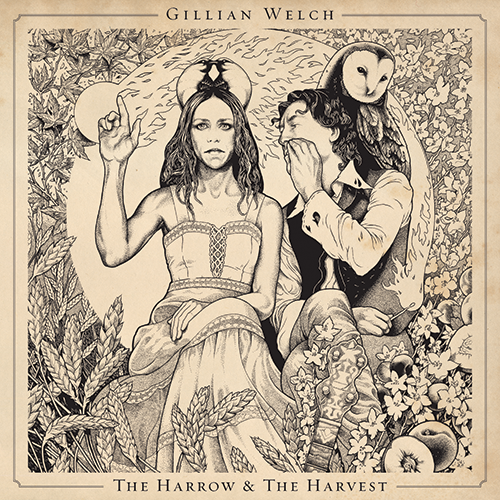
 If there is such a thing as a superstar in the Americana genre then Gillian Welch is one. Her debut album, Revival, came out in the height of Nashville stylized indulgence – hitherto known as the Garth years – and reached so far back in style and subject matter that it couldn’t be called old school, it predated the school itself. This New York City born and Berklee College of Music educated woman became a gabardine-clad personification mountain holler laments and sepia drenched Dust Bowl yarns. Like Duluth, Minnesota’s Bob Zimmerman she embodied the ancestral ghosts of mythology and willed herself into a contemporary symbol of a bygone era by exhibiting a respect for the cultural legacy and ingenuity to work within the confines to create music that sounds not only timeless but new.
To further distinguish herself , at the time of her debut many of Welch’s contemporaries were approaching their work from a folky, more Lilith-like, direction. Welch was rougher, darker, and delivered her talws with grit. Like Loretta Lynn and Wanda Jackson, she appeared to be a woman that could drink you under the table and hold herself in a fight.
After an 8-year stretch, where Welch battled writer’s block and provided a supporting role for performing partner David Rawlings solo undertaking, By plan or happenstance The Harrow & the Harvest has been released to coincide with the tenth anniversary of the Coen Brothers O Brother, Where Art Thou?, a move that in many ways reflects to neo-rustic forms crafted by Welch. The movie’s multi-platinum soundtrack was a watershed moment for the Americana music genre and featured Welch performing alongside better-known contemporaries Alison Krauss and Emmylou Harris. Welch also has a cameo in the film requesting a copy of the best-selling single from the movies fictitious group Soggy Bottom Boys.
On The Harrow & the Harvest Welch heeds timeless advice and doesn’t try and fix what’s not broken by offering up 10 songs of want and worry in many varieties. Scarlet Town opens with the protagonist visiting a town calamity and deception that would make Dr. Ralph Stanley bow his head in woe. The darkness of the songs subject is countered dazzlingly by David Rawlings deft guitar picking.
The murder ballad Dark Turn Of Mind carries a sinister undercurrent that belies it’s lulling cadence with a come-on / threat “take me and love me if you want me, but don’t ever treat me unkind. ‘cause I had bad trouble already, and he left me with a dark turn of mindâ€
The Way It Will Be is a smooth-folk Crosby, Stills and Nash-like that takes the associated SoCal groove to darker regions and The Way It Goes is a jaunty ode to weary fatalism that comes from a worn soul.
Tennessee is a character study in temptation and willful sin in the best Puritan tradition of the Southern Gothic form. The arch leads us from Sunday School to carousing, dancing and gambling all leading to the sweet bye and bye. The Way The Whole Thing Ends fittingly as it saunters and offers up hillbilly existential nuggets like “That’s the way the cornbread crumbles. That’s the way the whole thing ends.”
All in all The Harrow & the Harvest is a, paraphrasing from the song Scarlet Town , a deep well and a dark grave of an album brimming with hard truths as plainly told stiff as a pull of mash. It’s a fine return to form from an crafts-person that has been sorely missed. It’s the feel bad album of the summer

[dailymotion]http://www.dailymotion.com/video/xjlgyy_gillian-welch-the-way-it-goes-conan-2011_music[/dailymotion]




 On his second release Joe Thompson takes us on a journey of a man caught between two worlds – the American northeast and the southwest. His birthplace of Western Pennsylvania, his current residence of New York City and Texas, the source of his lineage (the birthplace of his parents if the narrative in Texas waltz is factual.) All play a part in the shifting landscapes of Yankee Twang, but it appears that in this struggle of geographic and identity the main source of aesthetic inspiration is the Lone Star State.
 Country and blues music has always mined the life’s mundane moments and extracted nuggets of domestic mythology shimmering with love, lust, booze, blood, tears, asphalt and diesel fuel. With these elements masters like Hank Williams Sr., Neil Young, Townes Van Zandt and Bob Dylan – and latter day troubadours like Bruce Springsteen, Steve Earle and Chris Knight – transcend whatever genre they are bridled with and forge minor pedestrian masterpieces.
 There appears to be a resurgence of sorts of the modern troubadour. the male singer/songwriter armed with only an acoustic guitar and the stories he weaves always teetering on the precipice between emotional authenticity and cloying sentimentality. The balance becomes even more precarious when you have pop leanings as the term “pop” has been severed from it’s root “popular” into something fleeting and vapid.