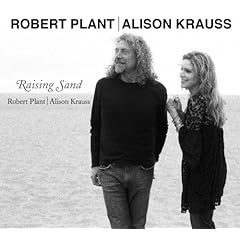
Review – Robert Plant/Alison Krauss – Raising Sand (Rounder)

Country music has some great male/female duos – Tammy Wynette & George Jones, Dolly Parton & Porter Wagoner and now… Robert Plant and Alison Krauss? No really, let me ‘splain.

While Mssr. Plant and his partner in sonic larceny Jimmy Page spent most of their time pilfering Robert Johnson’s crossroads they never left the dirt roads to traverse the back woods and smokey mountains where Americana, country and roots music flourished. In plant’s own words “I completely missed a whole other area of amazing American music.”

The collaboration between the blonde bluegrass angel and blonde rock god was set in motion seven years ago when the two sang together at a 2004 Leadbelly tribute concert. The conduit to the to bring the project together came in the form of producer and musician T-Bone Burnett (‘O Brother, Where Are Thou’ and ‘Walk The Line’.)

The result is a moody hushed world where sepia tinted country, fringe-folk and swaggering rockabilly fuse into a surprisingly cohesive whole. Like an unlikely collaboration between Angelo Badalamenti and Sam Phillips the alchemy on these thirteen sparsely-arranged cover versions is raw and mesmerizing – Krauss sings like a shimmering Nightingale, and sets a perfect counterpoint to Plant purr and growl. In tandem, they frequently reach moments of true transcendence last heard when Plant dueted with Sandy Denny on Zappelin 4’s (or Zoso) haunting mandolin-driven folk ballad “The Battle of Evermore.”

As you might expect of a recording of this pedigree the musicians are top of the line. Burnett’s hired guns Marc Ribot (guitar), Dennis Crouch (bass), Jay Bellarose (drums) and Norman Blake (acoustic guitar) are solid but restrained. Burnett has a knack for perfecting the early country and roots high lonesomeness that conjures hard fate and hone-spun menace that can only be labeled dark Americana.

The covers are picked with care with attention to diversity and songwriting mastery. Doc Watson’s “Your Long Journey”, Tom Waits and Kathleen Brennan’s “Trampled Rose”, Gene Clark waltz “Through the Morning, Everly Brothers’ “Gone, Gone, Gone (Done Moved On)” and, most impressive, a discordant rendering of Townes Van Zandt’s “Nothing”and a Plant and Page number Please Read The Letter.”

Krauss and Plant trade solo and duet in deliriously beautiful harmony. I haven’t heard a duet release this good since Caitlin Cary and Thad Cockrell’s 2005’s release “Begonias.

http://www.youtube.com/watch?v=g5KF4dKq-6I
Grammy Committee Says Merle Haggard’s “The Bluegrass Sessions” Is Not Bluegrass

I came across this a few days back and I thought that after a few days the Grammy folks would do the right thing and allow Hag;s release to qualify as “bluegrass.” I guess I gave them too much credit.

Nashville, TN…McCoury Music, the artist-owned and operated label that released legendary singer/songwriter Merle Haggard’s The Bluegrass Sessions on October 2nd, expressed its shock today at a National Academy Of Recording Arts & Sciences committee’s decision to exclude the acclaimed album from consideration for nomination in its “Best Bluegrass Album” Grammy category. The label, created by legendary bluegrass artist Del McCoury in 2004, earned its first bluegrass Grammy in 2005 with the Del McCoury Band’s The Company We Keep.

“Anyone who knows the bluegrass community knows that its members like to debate definitions,” McCoury Music’s General Manager Chris Harris said. “But this is an album that Merle and Del decided to call The Bluegrass Sessions, produced by a bluegrass musician with bluegrass musicians, recorded at a bluegrass studio, released on a bluegrass label, racked under bluegrass in record stores, aired on bluegrass radio, covered by the bluegrass press, and it’s currently in it’s fourth consecutive week at # 1 on Billboard’s Bluegrass chart. If that’s not enough, even The Washington Post wondered why ‘no one had thought to pair Merle and Bluegrass together before.’ ”

McCoury, who holds nine International Bluegrass Music Association (IBMA) Entertainer of the Year awards, expressed his disappointment personally. “Merle did everything in his power to make this record authentic except remove that unique Haggard sound–and that’s something he’s brought to every genre of music he’s ever visited,” McCoury said. “Merle Haggard could make a polka record, and there’d be no mistaking it’s Merle Haggard.”

Album producer Ronnie Reno, a bluegrass veteran who earned his spurs performing with two Bluegrass Hall of Fame artists–father Don Reno’s Reno & Smiley and the legendary Osborne Brothers–before spending some eight years in Haggard’s band, reacted in a more down to earth fashion: “that’s pure bullshit.”

Recorded at Ricky Skaggs’ Hendersonville, TN studio, The Bluegrass Sessions features Haggard backed by an all-star–and all-bluegrass–cast of musicians that includes such IBMA award winners as fiddler Aubrey Haynie, dobro player Rob Ickes, guitarist and harmony singer Carl Jackson and Alison Krauss.

As veteran mandolin player Marty Stuart, who got his own youthful career start with Hall of Famer Lester Flatt (Flatt & Scruggs) in the 1970s, wrote following the recording sessions, “Merle Haggard has put the blues back into bluegrass. I was honored to be there alongside of him when he did it.”

On its release, The Bluegrass Sessions rocketed to the top of Billboard’s bluegrass album chart, racking up the legend’s highest first-week sales for a new release since 2000, and Merle’s first #1 on any of Billboard’s charts since 1984. Bluegrass Sessions is currently enjoying it’s 4th consecutive week at the top of the chart. There has been solid support from the Bluegrass media, from the monthly magazines to the increasingly popular Bluegrass Blog, the winner of this year’s IBMA Media Award, in addition to features in mainstream media such as TIME Magazine and major newspapers across the country,

“When I contacted NARAS, they would not identify the committee, their qualifications, or why they don’t classify this album as bluegrass. Their stance just doesn’t make sense. With that said, of course, we’re grateful that members can at least vote for The Bluegrass Sessions in other country categories, including Country Album of the Year,” Harris said. “But by every reasonable definition, this is a bluegrass album, and we–Merle, Ronnie, Del and everyone involved in the project–think that Academy voters ought to be able to consider it for Best Bluegrass Album.”

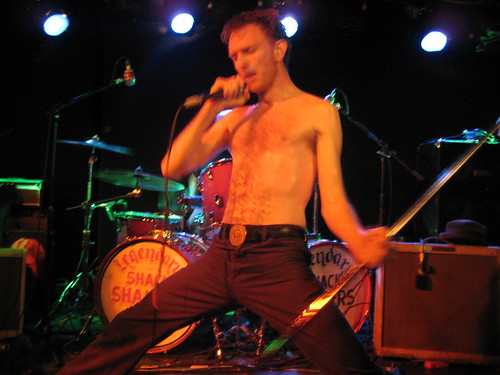
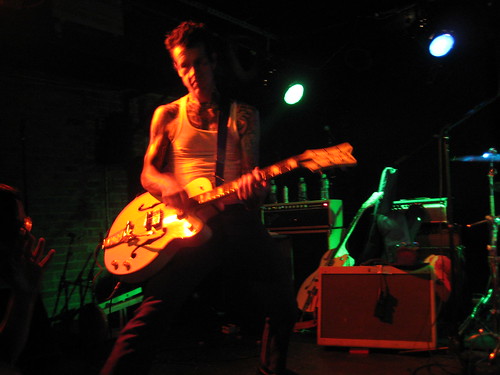
The Legendary Shack Shakers – Mercury Lounge – New York City – 11/08/07

If you’re a Legendary Shack Shakers fan try and describe the band to a friend when they ask predictable “What do they sound like?” Just watch as their eyes glaze over and smoke pours out of their ears when you say “They’re kind of a blues, rockabilly, country, punk-rock, Gothic (not goth) with a touch of the occasional klezmer influence.”

The whole sonic-stew is seamless at the ear-splitting, breakneck-pace of a LSS show. Featuring Paducah, Kentucky’s featherweight front-man Colonel J.D. Wilkes singing, playing harmonica and mugging like a vaudeville performer on meth. Stalking the stage, contorting his stringbean form, speaking in tongues and testifying about drifters, the Devil and elusive salvation. Think a Pentecostal Iggy Pop.

South Carolina’s David Lee, the LSS’s heavily tattooed guitarist, mercilessly punished his Gretsch White Falcon guitar like it needed a lesson learned. Lee’s not a flash kind of guy, he approaches the guitar like a construction worker does a jackhammer. He makes the machine a part of him to change the characteristics of the landscape surrounding him.

Mark Robertson slapped his stand-up “outhouse” bass laying a solid slab for Brett Whitacre’s frenetically-controlled drum work.

The hour-and-a-half show packed in cuts from the newly released “Swampblood” (“Old Spur Line,” “Hellwater“) as well as the excellent “Believe” (“Agony Wagon,” “Where’s the Devil When You Need Him?”) and the rest of the bands history that the time seemed go by in a sweaty, frantic, split-second.

For such an aggressive show the New York crowd was impressively animated yet subdued. Lots of yelling and fist-pumping but no moshing in sight.

For most right-thinking folk the Shack Shakers’ firebrand of Dixie-core might be a bit too potent a brew. For others that can trace the cultural link between the 50’s Sun Studio and the 70’s CBGBs, and has a wondering lust for genres, then it’s tonic for the soul.

Alabama’s Pine Hill Haints opened the show with their own brand of backwoods honky-Gothic tunes.

AMA Conference Highlights

This is just brief rundown on events here in Nashville at the Americana Music Association conference. I will add more detail next week.

Meeting Barbara Lamb, Sunny Sweeney, Chip Taylor, Kendal Carson, Gurf Morlix , Stacy Earle and Janet Reno!

The Halloween tribute to the memory of Porter Wagoner with Mark Ferris, Rodney Crowell, Jim Lauderdale and Emmylou Harris.

Seeing Darrell Scott at the Station Inn.

The AMA Awards at the Ryman Auditorium (the Mother Church of Country Music) featuring Joe Ely, Guy Clark (in a tribute to Townes Van Zandt) , Lyle Lovett, The Avett Brothers, Patty Griffin, Old Crow Medicine Show, Darrell Scott, Buddy Miller, Jim Lauderdale and Emmylou Harris.

Eating Jacks BBQ and drinking Big River Brewery beer.

Visiting the Hatch Show Print studio.

Wagonmaster’s Rolling – Porter Wagoner 1927-1007

Grand Ole Opry member and country music legend Porter Wagoner has died at the age of 80. He had been diagnosed with lung cancer and listed in serious condition and was released from a Nashville-area hospital to a hospice to be with his family.

In May, he celebrated his 50th anniversary as an Opry member during a special segment of the show hosted by Marty Stuart and featuring guest appearances by Patty Loveless and Wagoner’s longtime duet partner, Dolly Parton. Wagoner was inducted into Country Music Hall of Fame in 2002.

I was lucky enough to recently see Mr. Wagoner perform in support of his excellent new release “Wagonmaster” which was released earlier this year. I briefly met the man after one of the shows and he seemed genuinely touched and overwhelmed that people still wanted to see him perform after all these years. I do belive he left us doing what he was born to do. What he did best.

[youtube]http://www.youtube.com/watch?v=175nWTFs1yQ[/youtube]

The Roots of Led Zeppelin

 If songs like “Down By The Seaside,” “Gallows Pole” and “Bron-Y-Aur Stomp” didn’t convince you that Led Zeppelin had occasional detours off the road to Clarksdale to the Appalachians, or at least Nashville, then maybe the words of the alt.country/roots music impresario T-Bone Burnett, who produced the great new CD Raising Sand with Robert Plant and Alison Krauss (review soon) will convince you:

“People confuse Led Zeppelin with what came after them, as if they were a heavy metal band. But the incantations that Robert was singing were drawn from the Delta and the Appalachian mountains. It was music of the mud and earth. They had many gears they could go up, but at its essence was something raw and true and authentic.”