CD Review – Molly McGinn – Girl with Slingshot

Some artist produce “Americana” music in a spirit that is akin to a gumbo or a stew. A medley of accompanying flavors melding together into something that is definitely more than the sum of it’s parts. Dodge City, Kansas native and current Greensboro, North Carolina resident Molly McGinn‘s pedigree through her musical career has covered everything from jam-band to ska and reggae, so it’s not surprising MS. McGinn’s take on Americana, “Girl with Slingshot” (dotmatrix) utilizes these influences in a recipe that works to great and surprising effect.

Ms. McGinn is a vocalist with a style that is an equal blend of cool urbanite and earnestly sincere Southern girl. An example of the former is exhibited in the first cut Kill Devil Hills, a smooth folk-jazz snapshot of life which is delivered with a hep scat-like staccato and cloaked in a reverb drenched vibe. The latter comes though in the lovely slide guitar paired gospel-country tune “Preacher and Thieves” which is a song that would have easily for in Neko Case’s earlier Southern-gothic catalog .

“Bad Jokes and Blues” takes me to a smoky L.A. beat-club circa 1967 and offers one of the best one-liners I’ve heard in a song about love “Please don’t dull my eccentricities.” “Beautiful Ugly Man” sound like a funky beat-box rave up with a Suzanne Vega at the helm. Intimate and literate lyrics wrapped in poignant and sophisticated arraignments that never leaves you cold.

Molly McGinn is not an easy artist to pin down and her Jedi-like genre bending seems natural and not contrived or clever. I believe she is a talent to watch.

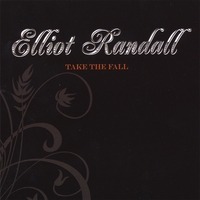
Elliot Randall – Take the Fall (self released)

Elliott Randall is a man to watch.

Randall, not Elliott Randall the ex-Steely Dan guitarist best known for his guitar solos on Reelin’ in the Years, but the Bay area by-way-of Charleston, South Carolina, alt.country rocker has a lot going for him. On first listen it’s easy to be lazy and compare Elliot Randall’s superb release “Take the Fall” (self released) to some of Ryan Adams best work.

For instance take the melancholy slide-guitar and Rhodes keyboard steeped “Elephant” and the soul-wrenching title track, Randall sounds much like he’s channeling Adams more soulful moments. But Randall is his own man and as an artist he’s in many ways more focused in his compositions than Adams has been of recent. “How to Get Old” is a damn fine song that could have come from Uncle Tupelo with little mainstream Nashville hook added in to sweeten the experience. It works skillfully and without coming off as sterile and contrived. More Early Guy Clark storytelling than Kenny Chesney clichés.

Barn-burning rave-ups like Don’t Give Up On Me” and “Leaving This Town” show that the man can get a room moving when he wants to.

A recent feature on an Americana Roots podcast, Randall straddles the country and rock worlds proficiently and his work sounds both timeless and fresh.

Review – Ryan Adams – Easy Tiger

Alt.country/rock enfant terrible Ryan Adams once threw a hissy fit and attempted to toss a fan out of the Nashville Ryman Auditorium when during an Adams concert a member of the audience yelled “play ‘Summer Of ’69,'” referencing the hit by Canadian superstar Bryan Adams.

With his new release Easy Tiger (Lost Highway), Ryan is finally making peace with his inner Bryan.

This is most mainstream release Ryan Adams has ever done. That not to say it’s mainstream, we are still talking about the guy that channeled Beck and posted dozens of faux hip-hop and punk tracks like “Awww Shit, Look Who Got a Web Site”
Is he brilliant or nuts? Who cares?

Recorded with his Cardinals but billed as a solo effort, Easy Tiger is a taunt release with the longest track clocking in at 4:11 and most are two or three minutes this focusing and freeing Adams to create some of his best work.

Things kick off with “Goodnight Rose”, a stunning country-rock tune that is as straight forward as it is surprising in its composition and excellent guitar work. “Two” is a sweetly heart-wrenching song with barley discernable vocals by Sheryl Crow.

Halloween Head is a rave up with a free-jam feel and “Oh My God, Whatever, Etc.”, brings to mind Sufjan Stevens with its hushed vocal and delicate piano and softly plucked banjo. But it ends up all Adams
The frustrating thing about Ryan Adams is that much of the gushing ink spilled on his musical genius is sometimes very often, true. When he’s good he’s approached legend, and when he’s just okay he’s still pretty fucking great!

Ryan Adams – Two

Dale Watson – From the Cradle to the Grave Review

Is country music dead? If the cover of the new Dale Watson release “From the Cradle to the Grave” contains any insight the answer is a resounding yes. There Dale stands like a hybrid Pauly Walnuts from the Sopranos and the Unknown Hinson looming sepia soaked in a grave yard. Just behind him on a a headstone is inscribed the verdict – “Country Music R.I.P.” Dale has every reason for writing an obituary, from the Grand ‘ol Oprey’s shafting of older members, big box retailers strangling of music distribution, radio’s rigid top seller play list and the biggest star in country coming from a dismal reality show you’d think death might be the best thing to happen to the genre.

Ten songs in three days. That’s how long it took Watson to write and lay down the tracks in a Hendersonville, TN. cabin formerly owned by Johnny Cash (currently owned by Johnny Knoxville.) Dale has said in interviews says at first he was adamant about not writing or recording anything remotely reminiscent of Johnny Cash but the specter of Cash, technique as well as themes, runs throughout the entire album.

But instead of merely a derivation “From the Cradle to the Grave” sounds like pure Dale Watson. One of the great things
about country music is that the great artists aren’t afraid to wear their influences on their sleeves. Dale displays not
only Cash, but Haggard and Waylon as well.

The Cash DNA boom-chuka-boom runs deeply to excellent affect in the opening “Justice For All,” a song about the between the law and a personal desire for vengeance. The stripped down Tennessee Three sound of Hollywood Hillbilly, a song about Johnny Knoxville, is as no frills as you’re about to find.

The Bananza-like big range sound of “Time Without You” gallops along at a fine pace. “Yellow Mama,” a dark yarn about a life gone wrong and the electric chair waiting at the end. The apocalyptic vibe reflects onward in “Tomorrow Never Comes” with it’s zen like observations of time.

Cash gets a formal call out at the end of “Runaway Train” with lyrics quoted directly from some of the Man In Black’s best known songs. “I hear that train a comin’ / hey Porter, oh Porter / yea I don’t care if I do die do die do die.” closes out the song and this all too short album.

Thanks Dale’s enduring and brave 25-year career and to this album, to paraphrase the late, Great Mark Twain, the rumors of country music’s death has been greatly exaggerated.

four and a half stars

Elizabeth Cook – Balls

Balls is the boldly titled release by Wildwood, FL. native Elizabeth Cook. With singer, songwriter and ex-guitarist for Emmylou Harris’ Hot Band Rodney Crowell sitting in as producer the release has one boot astride in contemporary swagger and one firmly planted in tradition.
I’m new to Ms. Cook, but apparently she’s been around a spell and is the hottest thing I never heard of. She made her Grand Ole Opry debut on March 17, 2000, and appeared repeatedly thereafter, which is a remarkable achievement considering that, at the time, she was an indie artist with zero radio airplay.

The album kicks it off right with “Times Are Tough In Rock ‘n’ Roll” – A celebration of country music bounces along with a jaw harp boinging throughout. The song softly disses on rock music, thought with the singling out of Britney Spears I wonder if it’s really pop music that is being tarheted with this fun tune.
“Don’t Go Borrowin’ Trouble” follows with a slow-burning lament that looking for bad times leads to you just might finding some.

The song that begets the title, “Sometimes it takes Balls to be a Woman” is next – Like many great country songs recorded by woman it’s both boldly declarative and coyly playful. A nice shuffle and some mean guitar work by the Nashville master Kenny Vaughn drives this baby all the way home. Cook does a shout out to Loretta and Dolly just to let folks know she knows who paved the path she’s now gracefully walking.

A duet with alt.country rocker Bobby Bare Jr. on the “Amazing Grace” reminiscent “Rest Your Weary Mind” sets Bare’s woozy rasp against Cook’s pitch perfect voice blended to fine effect with acoustic guitar, mandolin and soulful fiddle.

“He Got No Heart” is a slight boom-chucka tune about some no good dude that’s done this girl no good (he got no heart/his mama forgot that part) and makes feeling bad a lot of fun.

“Mama’s Prayers” is a pious tear-jerker about mama loving her while she’s out in this mean ‘ol world that wins because of it’s sincerity.

“What Do I Do” is a great song in the vein of classic Tammy Wynette of love on the skids.” Gonna Be” is a toe-tapping song of gumption and wherewithal.

An independent sprit shines throughout this fine album. Cook has a voice that is as clear as a crystal pond and strong enough to belt out a song that leaves the Underwoods and Wreckers in the dust. It’s easy to draw a line in the country lineage from Loretta and Dolly to Elizabeth Cook.

Trilobite – Trilobite

Albuquerque, New Mexico based band Trilobite – a.k.a. Singer, songwriter, Mark Ray Lewis fancies himself a “fictionist”, but unlike most creative writing 101 wankers who strive to be the second coming of Zimmy Mr. Lewis has the literary cred to back it up.

He was a Wallace Stegner Fellow at Stanford and won the O. Henry and Pushcart awards for  his short fiction piece Scordatura — which featured an introductory note by Dave Eggers, and was nominated by Joyce Carol Oates. Not too shabby.

From the sound of this self-titled release Mr. Lewis has also studied the atmospheric Southern  Gothic gospal of Jim White. There is a nod to the old-school – fiddle, pedal steel, banjo,pump  organ – but then the music becomes a beautiful bastard hybrid that surprises.

Like White Mark Ray Lewis has a voice made for stories. Coaxing expression and depth out of his simple, straight-ahead delivery of dark myths. And like other great “fictionist” his stories are never obvious or staightforward, but the stories draw you in and keep you listening.

The release begins with Pumpkin Farmer, the strains of fiddle a loping cadence andbackground vocals Michelle Collins provides a cupie-doll rasp to harmony on this gem. Man of God uses a Wobbly pedal steel to lay the solumn mood which is then shards of a clawhammer banjo and draw of a fiddle and cello provide warmth to an otherwise chilly tune. The Ledge is a beautiful, haunting oblique tale of hunting tragedy. The Caves of Burgundy is almost a jangly, joyful tune until the whispered, fragmented, misaligned harmony weaves into a song of lust or death, hard to tell. Snakeriver is a bloody Texas two-step tha  sound like it’s being delivered from the bottom of a cavern and evolves into a Southwestern stew of schizophrenic music styles that still comes out sounding coherent and lovely. Samsara is a stormy piece laid over a muffled phone message like a call from the afterlife.

This is a dark and lovely slice of Americana that embraces tradition while it moves the genre in new and interesting directions.

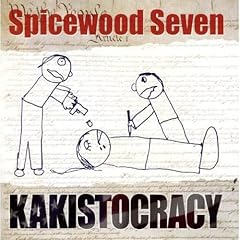
Spicewood Seven – Kakistocracy

The simple-minded view of country music as a soundtrack to the religofasict faction of red state America completely ignores the poor, working class roots of country music and the and the multifaceted, complex great artists that created it. Sometimes a release reminds you of all of that and does it in spades.

Texas’ Spicewood Seven brings us Kakistocracy (rhymes with democracy), meaning “government by the incompetent and corrupt, and in the midst of the current Bush administration I’d say that’s about right.

Keeping up the tradition forged by the likes of Kris Kristofferson, Johnny Cash, Willie Nelson. Loretta Lynn, Steve Earl and many others Kakistocracy is a condemnation of the corruption of American values by the powerful elite. Great music has always been created in response to war. From Woody Guthrie to Crosby, Stills, Nash and Young – the horror of war cries out for artists to address it.

Led by lyricist Luke Powers and multi-instrumentalist Tommy Spurlock (a longtime stalwart of the Austin music scene who’s recorded with everyone from George Jones to Shania Twain), the Spicewood Seven include guest shots from a variety of names both well-known (Garth Hudson of the Band adds organ) and some less-so – Leon Rausch, Brennen Leigh, David Hearne, Elana Fremerman, Jimmy Karstein, Rosie Flores, Jane Bond. All songs were written by Tommy Spurlock and Luke Powers, the disc was mixed and produced by Tommy Spurlock for Austin Records.

Song themes run from the Iraq war (“Crawford, Texas,” and “Going Down the Road to Baghdad”) and the blight of methamphetamine on rural America (“Crystal Time”). Protest music succeeds or fails by the same standards all music does, is it boring? Spicewood Seven makes music that speaks to your mind but also moves your ass.

Much fuss was made a couple of years ago when Green Day released the punk-opera”American Idiot” in response to the buffoons in Washington. Kakistocracy makes American Idiot sound like easy listening.

(I’m Goin’ Down to) Crawford Texas(mp3) 

Going Down the Road to Baghdad(mp3)

Terry Flynn – Again Tonight

When I was at the one of the Mercy lounge showcases for the Americana Music Conference I was in the upstairs room waiting for Marty Stuart I ran into a frietndly fellow with a chair right near the front. We chatted for a while, shared a beer. He said his name was Terry Flynn and he handed me his CD, Again Tonight.  “I hope you like it” he said before I lost him in the crowd. I’m here to say I do.

Atlana native Terry Flynn has a country-soul voice like Ray Price for Elvis in his early hillbilly years. His songs about love found lost and found again. Sorrowful hope. Atlanta is a lovely song to his home state and a woman returning from New York. “Still In Love With You” is a slow burning rockabilly tune that delivers and the title song begins with a Spanish style guitar into and then kicks into a full rave. This is a great release from a fine and genuine artist.

Hag: The Best of Merle Haggard – Pitchfork Review (8.8)

Pitchfork has a fine review of Hag: The Best of Merle Haggard.

an excerpt:As an introduction to Haggard’s music– or even to  the Bakersfield sound that he helped popularize– Hag may be  unparalleled. Born in Bakersfield to transplanted Oklahomans,  Haggard was at heart a California artist, reared on 1940s and
50s country and influenced by Bob Wills, Tex Ritter, and Spade Cooley. You can hear their influence– especially Wills’– in songs like “Living with the Shades Pulled Down”, on which Haggard calls out his band members to solo, adopting a falsetto much like his hero’s. It’s an original tune, but it could very easily be a Wills cover.

Hag recently collaborated with another Country legend, George Jones, on the release ”
Kickin’ Out the Footlights…Again.”

Johnny Cash At San Quentin (Legacy Edition) – Pitchfork Review

The fine folks at Pitchfork have posted a really nice review of the Legacy 2-CD 1-DVD release of Johnny Cash’s performance at California’s oldest state prison, San Quentin.

An excerpt: Cash’s decision to strum up a jail probably had as much to do with his own burgeoning mythology– the Man in Black, the cold-blooded killer, the anti-Nashville rebel– than any desire to remedy the U.S. prison system (although Cash did eventually actively advocate prison reform, meeting with President Richard Nixon in July 1972). All the ethical snafus inherent to the deed– it’s easy to argue that Cash exploited the convicts’ plight to buoy his own rep, or to sympathize with the families of the prisoners’ victims, who might not want to see their loved ones’ killer clapping his hands to “A Boy Named Sue”– are hard to dismiss, but At San Quentin is still a spectacular musical performance, one of the most mesmerizing live records in American history.